

Canada Online News Act (C-18): Economic Impact and Repeal Probability
Nearly three years after Bill C-18's passage, the bifurcated outcome persists: Google pays $100M CAD/year, Meta maintains a complete news block since August 2023. Canadian news outlets saw an 85% drop in Meta engagement, approximately 11 million fewer daily news views, and about one-third of local outlets have gone inactive on social media. The CRTC confirmed no regulatory action is planned against Meta. The key irony: C-18 was designed to make platforms pay, but the main outcome is $100M from Google while Meta proved the legislation unenforceable.
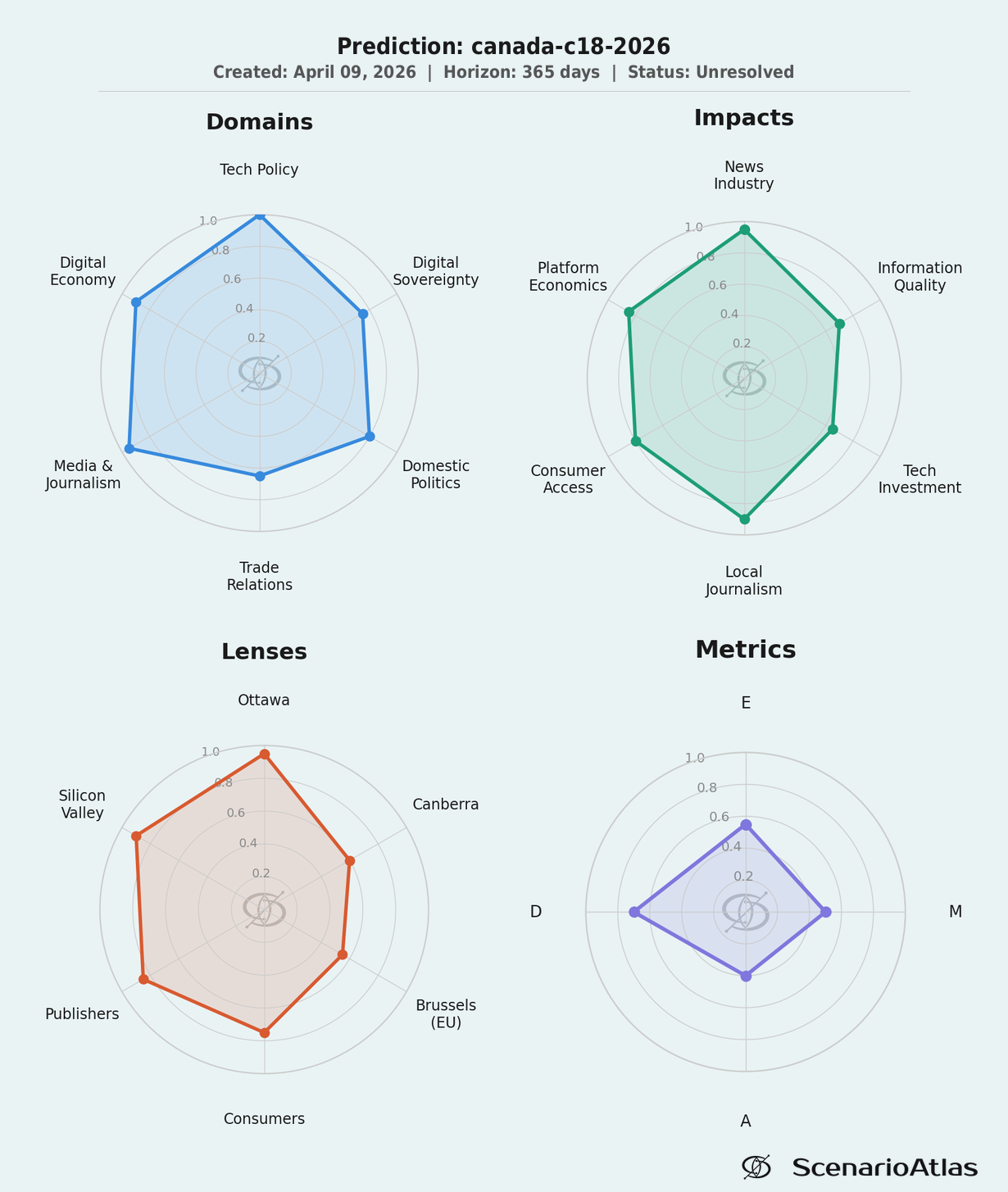
Probability Scores
Current Situation
| Metric | Value |
|---|---|
| C-18 Royal Assent | June 22, 2023 |
| Google Payment | $100M CAD/year via Canadian Journalism Collective |
| Meta Status | Full news block since August 1, 2023 |
| Meta Engagement Drop | 85% |
| Daily News Views Lost | ~11 million |
| Local Outlets Inactive | ~1/3 went inactive on social media |
| CRTC Action on Meta | None planned (Dec 2025) |
Five Scenarios
1. Status Quo Persistence
C-18 remains with minor adjustments. Google continues $100M/year. Meta maintains indefinite block. Large publishers receive ~$60-70M/year via CJC. Small outlets continue declining.
Drivers: Institutional inertia, sunk political capital, large publisher lobbying. CRTC confirmed no action — path of least resistance.
2. Public Funding Pivot
Government pivots to hybrid: maintains C-18 in reduced form while launching direct public investment — expanded Local Journalism Initiative, tax credits, sovereign journalism fund.
Drivers: Consensus platform payments alone can't save journalism. Carney's strategic investment orientation. Could appear in Budget 2026.
3. Full or Substantial Repeal
Conservative government or reformed Liberal government repeals C-18. Replaced with direct subsidies, tax credits, or market dynamics. Google payments cease.
Drivers: CPC election win + campaign pledge. US USMCA trade pressure. Evidence C-18 didn't reverse decline.
Blocker: Large publisher lobby fighting loss of $100M/year.
4. Negotiated Compromise — Meta Returns
C-18 amended with face-saving modifications. Voluntary fund replaces mandatory bargaining. Meta contributes ~$30-50M CAD/year, restores news links.
Blocker: Meta's entrenched position. Data shows minimal business impact from blocking. Precedent concerns globally.
5. Escalation — Expanded Regulation
Government expands C-18 to X, TikTok, Apple News, Reddit. Punitive measures against Meta. Risk: more platform exits, tech investment deterred, news ecosystem further fragmented.
Cascade Triggers
| Trigger | % | Cascade |
|---|---|---|
| Poilievre majority + USMCA pressure | 20-25% | C-18 framed as trade barrier → fast repeal |
| Major Canadian news org bankruptcy | 15-20% | Blamed on Meta block → public funding pivot accelerates |
| Carney snap election, loses | 10-15% | CPC government → repeal in first 100 days |
| Meta global settlement (Australia model) | 8-12% | Australia pays less → Canada forced to renegotiate |
| X/TikTok preemptive block | 5-8% | More exits → news ecosystem collapse |
What to Watch
Invalidation Criteria
This analysis would require significant revision if: Meta voluntarily restores Canadian news (would shift Meta Returns from 10% to 40%+); a major Canadian news organization files for bankruptcy and explicitly cites C-18/Meta block as cause; the US formally raises C-18 as a USMCA trade dispute; or the Liberal government announces C-18 repeal before an election.
Resolution Tracking
| Prediction | Deadline | Our Call | Outcome | Correct? |
|---|---|---|---|---|
| C-18 still in force (substantially unchanged) | Apr 2027 | 65% likely (status quo + escalation) | TBD | TBD |
| Meta still blocking Canadian news | Apr 2027 | 85% likely | TBD | TBD |
| Google still paying $100M/year | Apr 2027 | 75% likely | TBD | TBD |
| New public journalism funding announced | Apr 2027 | 35% likely | TBD | TBD |
| Conservative government in power | Apr 2027 | 30% likely | TBD | TBD |
Verdict
C-18 produced a split outcome: Google paid, Meta called the bluff. CRTC confirmed Meta wins this standoff.
The most likely path is status quo (40%) — institutional inertia makes fundamental change difficult even when policy outcomes are mixed. The public funding pivot (25%) offers the most constructive path but faces fiscal constraints and political optics of admitting C-18 failed. Full repeal (18%) requires a Conservative election win. Meta returning (10%) requires Meta to reverse a globally-significant precedent.
The deeper lesson: legislation designed to force platform payments works only when platforms value the content enough to pay rather than walk away. Google valued it. Meta didn't.
Confidence: 45%. Democratic process is observable. Key unknowns: election timing, whether Carney pivots, and Meta's global strategy.
Framework: D/E/M/A (Data Quality · Epistemic · Model · Aleatoric). Published 9 April 2026. All predictions scored on resolution.
References
Every prediction scored. Every miss published.