

Canada Fuel Tax: Carbon Tax Gone, What's Next?
The federal consumer carbon tax has already been eliminated as of March 2025 — fuel charge rates set to zero, saving Canadians ~18¢/L. But taxes still make up 30-40% of the pump price. Federal excise (10¢/L), "hidden" carbon from fuel regulations (~7¢/L in 2026, rising to 17¢/L by 2030), provincial taxes (9-19¢/L), and BC's provincial carbon tax (~18¢/L) all remain. The question now: will further taxes be cut?
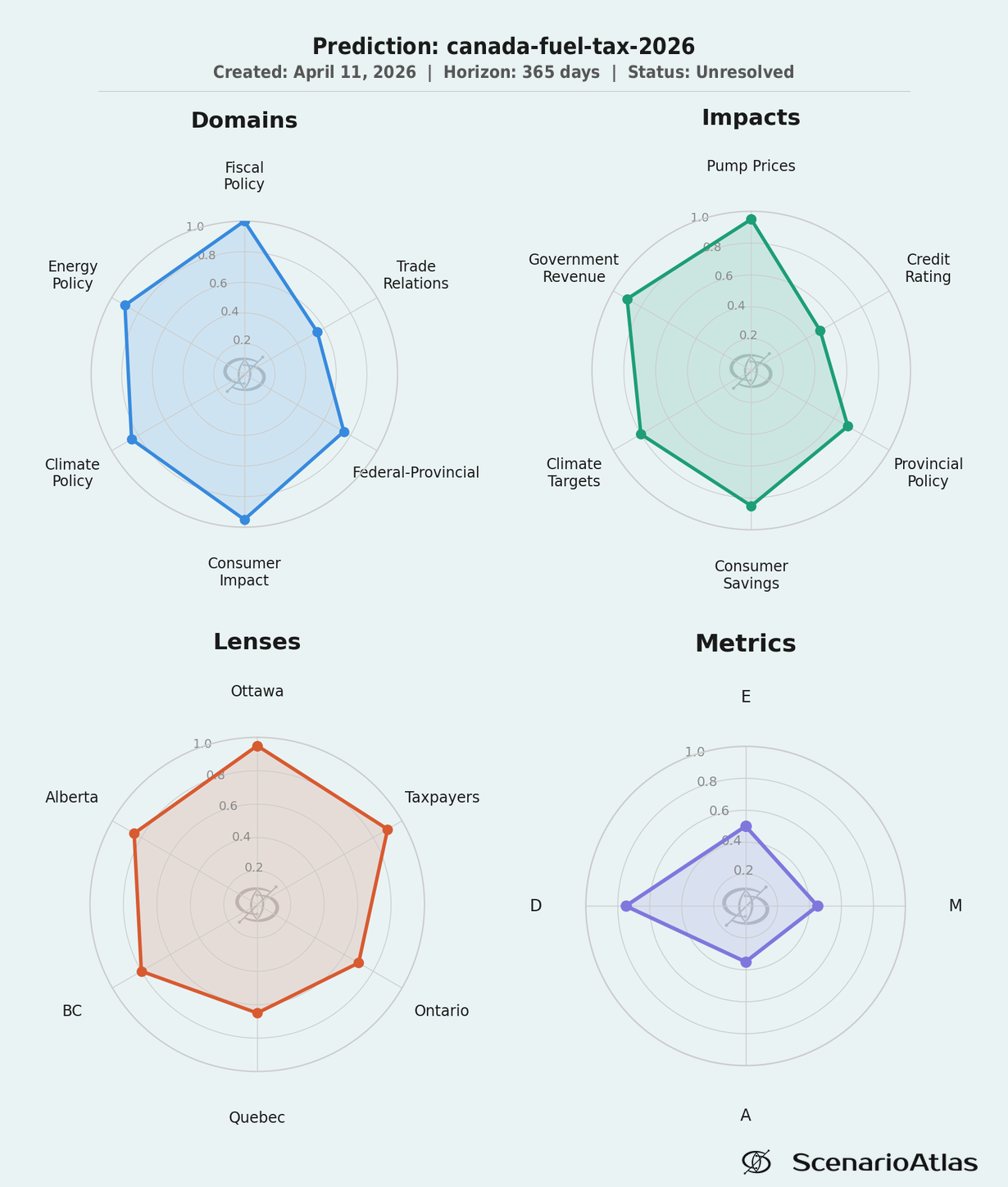
Probability Scores
Current Tax Breakdown (Gasoline)
| Component | Rate | Status |
|---|---|---|
| Federal Carbon Tax | 0¢/L | Removed March 2025 |
| Federal Excise Tax | 10¢/L | Active |
| "Hidden" Carbon (Fuel Regs) | ~7¢/L → 17¢/L by 2030 | Rising |
| GST | 5% of total | Active |
| Provincial Fuel Tax | 9-19¢/L | Varies by province |
| BC Provincial Carbon | ~18¢/L | Under review |
| Total Tax Share | 30-40% of pump price depending on province | |
Five Scenarios
1. Status Quo — No Further Cuts
Conservative government declares victory on carbon tax. Federal excise (10¢/L) and GST maintained. "Hidden" carbon from fuel regulations continues. Provincial taxes unchanged.
Drivers: Federal deficit ~$46B. Excise elimination adds ~$5.5B/year loss. Poilievre already delivered core "Axe the Tax" promise. Pump prices already dropped ~18¢/L.
2. Partial Federal Excise Cut
Temporary 50% excise cut (10¢ to 5¢/L) if oil spikes or recession hits. Framed as "Affordability Relief Measure" for 12-18 months.
Triggers: Oil above $90/bbl. Economic slowdown. International precedent (Germany, France 2022-23).
Blocker: Credit rating downgrade risk. Temporary measures become impossible to reverse.
3. Hidden Carbon Regulation Rollback
Government targets "hidden" carbon from Clean Fuel Regulations (~7¢/L now, rising to 17¢/L by 2030). Lower-profile than excise cut but prevents significant future cost increases.
Drivers: CTF and oil industry lobbying. Easier to frame as "regulatory relief." Minimal direct revenue impact.
4. Provincial Carbon Pricing Collapse
With federal backstop gone, BC reduces/eliminates provincial carbon tax (~18¢/L). Quebec weakens cap-and-trade.
Blocker: BC carbon tax since 2008 (~$2.5B/year revenue). Quebec linked to California. Strong environmental constituencies.
5. Full Excise Elimination
Maximalist: federal excise eliminated entirely, possibly GST from fuel. Combined revenue loss ~$18-20B/year — catastrophic. Requires severe crisis. Even most Conservative economists oppose. Credit rating downgrade likely.
Cascade Triggers
| Trigger | % | Cascade |
|---|---|---|
| BC NDP loses to BC Conservatives | 15-20% | Provincial carbon tax eliminated → fuel tourism ends → competitive pressure gone |
| Recession + deficit >$60B | 12-18% | Fiscal hawks vs populists — either NO cuts (austerity) or aggressive cuts (stimulus) |
| Oil >$100 sustained | 10-15% | Affordability crisis → excise cut politically unavoidable |
| Trump border carbon tariff | 8-12% | Canada forced to choose EU alignment (keep carbon policy) or US alignment (drop it) |
| Alberta sovereignty push | 5-8% | Federal fuel tax collection contested → constitutional crisis |
What to Watch
Resolution Tracking
| Prediction | Deadline | Our Call | Outcome | Correct? |
|---|---|---|---|---|
| Federal excise unchanged at 10¢/L | Apr 2027 | 70% likely | TBD | TBD |
| Clean Fuel Regulations rolled back or delayed | Apr 2027 | 25% likely | TBD | TBD |
| BC provincial carbon tax still in effect | Apr 2027 | 80% likely | TBD | TBD |
| No new federal fuel tax introduced | Apr 2027 | 95% likely | TBD | TBD |
Verdict
The main federal carbon tax is already gone. The question now is narrower — and the most likely answer is: no further cuts.
The 45% status quo probability reflects real fiscal constraints: a $46B deficit, infrastructure funding needs, and a prime minister who already delivered his core promise. The "hidden" carbon from fuel regulations (7¢/L now, 17¢/L by 2030) is the sleeper issue — less visible than excise but with growing consumer impact. If oil spikes above $90/bbl, the partial excise cut (25%) becomes much more likely.
Confidence: 55%. Domestic policy with observable fiscal constraints. Higher confidence than geopolitical predictions.
Framework: D/E/M/A. Published 11 April 2026. All predictions scored on resolution.
References
Frequently Asked Questions
Is the carbon tax still in effect in Canada 2026?
The federal consumer carbon tax was eliminated in March 2025. However, federal excise (10 cents per litre), hidden carbon from fuel regulations (7 cents per litre rising to 17 by 2030), and provincial taxes remain.
What replaced the carbon tax in Canada?
The fuel charge was set to zero but federal excise and clean fuel regulations remain. Status quo probability is 45%, partial excise cut 25%, regulation rollback 18%.
Every prediction scored. Every miss published.