

China Rare Earth Leverage: Four Scenarios for Supply Chain Warfare
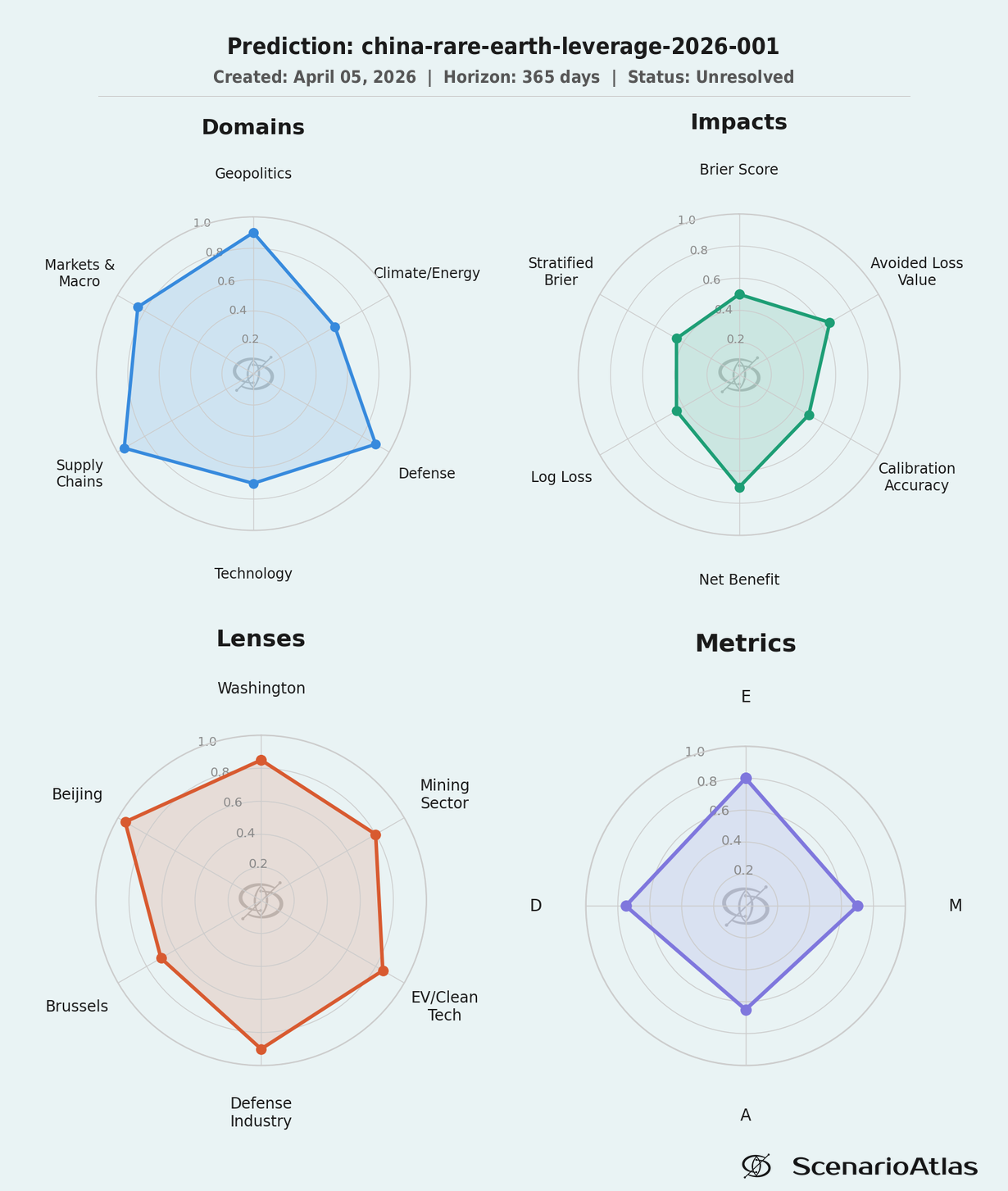
China controls 70% of global rare earth mining and 90% of refining capacity. In October 2025, Beijing applied the Foreign Direct Product Rule (FDPR) to rare earths for the first time - the same mechanism the US uses for semiconductors. This targets defense supply chains: F-35, Tomahawk missiles, drones. The Iran war is now exposing US tungsten and rare earth dependence in real-time. Base rate: China's 2010 rare earth restrictions vs Japan were 60% effective short-term but backfired long-term. Our D/E/M/A framework assigns 40% to trade war revival, 30% to supply chain realignment, 20% to economic concessions, 10% to technological shift. Confidence: 65%, L3.
Probability Scores
Base Rates: Why Rare Earth Leverage Matters
| Metric | Rate | Source |
|---|---|---|
| China rare earth mining share | 70% | USGS 2025 |
| China rare earth refining share | 90% | Concordia University Study 2026 |
| 2010 Japan restriction effectiveness | 60% short-term | Backfired: Japan diversified, prices collapsed |
| US-China tariff threats executed | 70% | 2018-2025 trade war pattern |
| Rare earth recycling rate | <5% | Despite 90%+ recovery potential |
| Semiconductor reshoring timeline | 5-10 years | Analog for rare earth capacity build |
The base-rate approach reveals a paradox. China's 2010 restrictions on rare earth exports to Japan (Senkaku Islands dispute) were effective in the short term - prices spiked, Japan scrambled. But long-term, it backfired catastrophically: Japan diversified suppliers, developed recycling technology, and rare earth prices collapsed by 2015. China's market share actually declined.
However, refining is the real chokepoint, not mining. Even if the US mines rare earths domestically (Mountain Pass, CA), processing must go through China. Building refining capacity takes 5-10 years and billions in investment. The October 2025 FDPR application to rare earths shows Beijing understands this leverage.
Context: Iran War Exposes Dependence
The ongoing Iran conflict has consumed US munitions at unprecedented rates. Foreign Policy reports that tungsten - used in armor-piercing rounds, missile guidance, and aircraft components - is running low. The same applies to rare earth magnets in precision weapons. The US has no strategic rare earth reserve (unlike the Strategic Petroleum Reserve for oil).
The October 2025 US-China rare earth truce (1 year) was an emergency measure. But with the truce expiring in October 2026 and the Iran war consuming stockpiles, Beijing holds significant leverage. The question is whether China will use it - and how the US will respond.
Four Scenarios with Market Impact
■ Trade War Revival
Triggers: FDPR retaliation, truce collapse, South China Sea escalation
Defense stocks: +15-25%
EV sector: -10-20%
Rare earth prices: +50-100%
Timeline: Q4 2026
■ Supply Chain Realignment
Triggers: US/allied refining capacity build, Australia/Canada partnerships
Defense stocks: +5-10%
EV sector: -5% then +10%
Rare earth prices: +20-30% stable
Timeline: 2027-2030
■ Economic Concessions
Triggers: US-China trade deal, mutual economic benefits
Defense stocks: -5%
EV sector: +10-15%
Rare earth prices: -10-20%
Timeline: 2026
■ Technological Shift
Triggers: Rare earth alternatives breakthrough, 90%+ recycling
Defense stocks: +10%
EV sector: +20-30%
Rare earth prices: -30-50%
Timeline: 2028+
Critical Elements Deep Dive
Heavy rare earths (Dy, Tb) are the true chokepoint. Neodymium and praseodymium (light rare earths) are more abundant and easier to source. But dysprosium and terbium - essential for high-temperature magnets in EV motors, wind turbines, and F-35 avionics - are almost exclusively processed in China.
The US Defense Production Act (DPA) has allocated funds for domestic rare earth processing, but projects are years from production. MP Materials (Mountain Pass) can mine but not refine to magnet-grade. Lynas (Australia) is building a US facility but won't reach scale until 2027-2028.
D/E/M/A Uncertainty Decomposition
D (Data Quality: 0.75) - Supply chain data is reasonably good; trade statistics, USGS reports, and company filings provide visibility. However, Chinese domestic consumption vs export figures have discrepancies.
E (Epistemic: 0.80) - High reducible uncertainty. Better intelligence on Chinese policy intentions, US-China backchannel negotiations, and Iran war munition consumption rates could significantly narrow probability ranges.
M (Model: 0.70) - Moderate model uncertainty. The 2010 Japan case provides a historical analog, but the refining monopoly dimension is new. No direct precedent for FDPR applied to minerals.
A (Aleatoric: 0.65) - Irreducible randomness includes: sudden technological breakthroughs, Taiwan crisis escalation, unexpected Chinese economic crisis forcing export prioritization.
What to Watch
Resolution Tracking
| Prediction | Deadline | Our Call | Outcome | Correct? |
|---|---|---|---|---|
| Truce renewal | Oct 2026 | 30% renewed, 70% expires/modified | TBD | TBD |
| Rare earth prices (NdPr) | Dec 2026 | +20-40% from Apr 2026 | TBD | TBD |
| US refining capacity | Dec 2027 | <10% of Chinese capacity | TBD | TBD |
| Defense supply disruption | 2026 | At least one program delayed | TBD | TBD |
Bottom Line
China's rare earth leverage is real but not absolute. The 2010 Japan case shows that weaponizing supply chains accelerates diversification - but diversification takes 5-10 years. In the short term (2026-2027), China holds significant leverage, especially over defense supply chains exposed by the Iran war. The most likely path is Trade War Revival (40%) followed by Supply Chain Realignment (30%). Economic concessions require political will that currently appears absent. Technological shifts are possible but not on a timeline relevant to current tensions.
Every prediction scored. Every miss published.