

Europe Sovereignty Turn: Four Scenarios for Defense Autonomy
European defense spending has increased 83% since 2015 - the largest increase of any world region. All 32 NATO members are expected to meet the 2% GDP target (up from 7 in 2022). The EU has taken on common debt for defense for the first time. The ReArm Europe / Readiness 2030 framework commits 800B EUR. Germany plans $77B over five years - potentially the world's third-largest defense budget by 2030. Trump's "pay-to-play" NATO model has landed as a planning assumption, not a hypothetical. Nuclear deterrence was high on the Munich agenda. Our D/E/M/A framework assigns 40% to "Fortress Europe", 30% to Transatlantic Reaffirmation, 20% to Strategic Autonomy Stalled, 10% to European Defense Realignment. Confidence: 60%, L3.
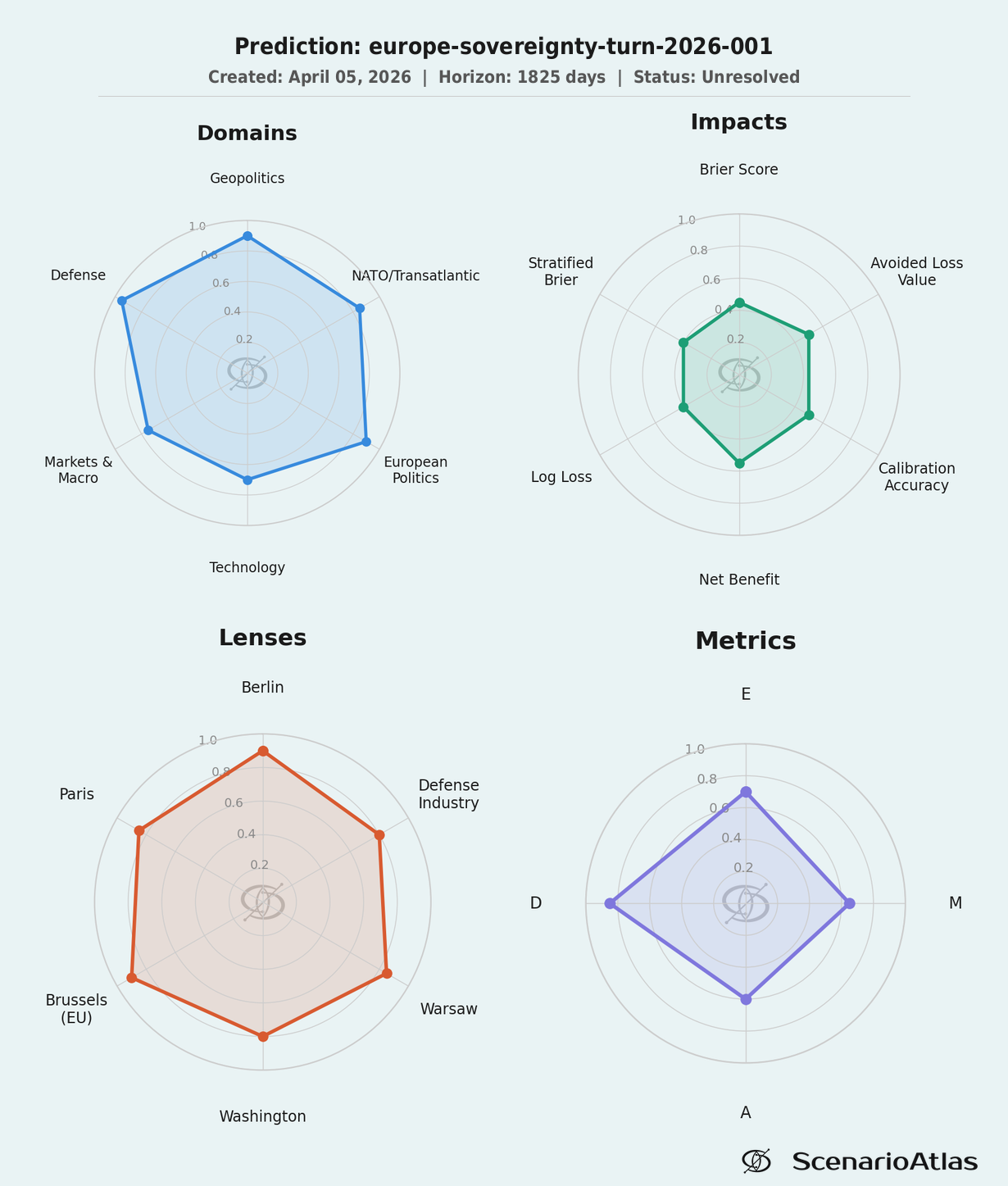
Probability Scores
The Numbers: A Quiet Revolution
| Metric | 2022 | 2025 | Trend |
|---|---|---|---|
| EU defense spending | 288B EUR | 381B EUR | +32% |
| European NATO spending | $477B | $563B | +18% |
| NATO 2% compliance | 7 members | 32 members | All |
| Germany defense budget rank | #7 globally | Projected #3 | By 2030 |
| EU common debt for defense | 0 | 150B EUR | First ever |
The Atlantic has described this as "a quiet revolution in how [the EU] exercises power." The EU taking on common debt for defense - decided in May 2025 - represents a fundamental shift. Previously, defense was strictly a national competence. The realization that even serious spending hikes in individual countries would vary widely given economic disparities forced this collective approach.
The Trump Catalyst
Reports in late March 2026 that the Trump administration was exploring a "pay-to-play" NATO model - where allies failing to spend 5% of GDP could be frozen out of Article 5 collective defense guarantees - landed in European capitals as a planning assumption, not a hypothetical.
Each new threat has moved the needle: not just in rhetoric, but in contracts signed, budgets passed, and procurement lists quietly rewritten to reduce dependence on American hardware. The most consequential shift is happening inside Germany's defense procurement office - contracts that would have gone to US suppliers two years ago are now being sourced from European or domestic alternatives where possible.
The Nuclear Question
At Munich Security Conference 2026, nuclear deterrence was high on the agenda. Several countries announced bilateral talks on the issue. The core challenge: to achieve a credible deterrent to Russia that is no longer - or at least less - dependent on US capabilities, European countries will have to work out their different strategic visions.
Two proposals have emerged: one relying entirely on conventional deterrence, another on extending French (and potentially British) nuclear guarantees. Both are insufficient on their own. A European deterrence strategy will need an integrated and holistic approach.
Four Scenarios for European Sovereignty
■ Fortress Europe
Drivers: Russian threat, EU debt for defense, ReArm Europe 800B, Germany commitment
Blockers: Economic strain, national divergence, tech dependence
Timeline: 2024-2028 buildup, 2032-2036 autonomy
Credibility: High
■ Transatlantic Reaffirmation
Drivers: Renewed US commitment (post-Trump), NATO 5% alignment
Blockers: US political volatility, fiscal disputes
Timeline: 2024-2026 coordination, 2031-2035 partnership
Credibility: Moderate
■ Strategic Autonomy Stalled
Drivers: Economic crises, political fragmentation, external dependence
Blockers: Political will, crises demanding response
Timeline: 2024-2026 momentum, 2027-2029 stall
Credibility: Moderate
■ European Realignment
Drivers: Independent identity, tech integration, Readiness 2030 success
Blockers: Coordination difficulty, nuclear consensus lacking
Timeline: 2024-2026 advance, 2032-2035 distinct actor
Credibility: Low
Capability Gaps: The ReArm Europe Targets
The ReArm Europe / Readiness 2030 framework identifies nine critical capability gaps:
| Capability | Current Status | 2030 Target |
|---|---|---|
| Air and missile defense | Fragmented, US-dependent | Integrated European shield |
| Strategic enablers | Limited (satellites, C2) | Autonomous space/cyber |
| Drones | Import-dependent | European production capacity |
| Maritime systems | National fleets | Interoperable EU naval force |
| Military mobility | Logistics gaps | EU-wide corridor by 2027 |
| Ammunition stocks | Depleted (Ukraine aid) | Strategic reserves rebuilt |
Base Rates: European Defense Integration
| Precedent | Outcome | Implication |
|---|---|---|
| EU defense integration (pre-2022) | Decades of talk, limited action | Crisis required for movement |
| Post-crisis spending sustainability | Mixed - Cold War sustained, post-2008 rapid cuts | Political will key variable |
| NATO 2% target achievement | 10+ years for most members | 5% will be slower |
| PESCO projects | 50+ initiated, few operational | Implementation challenge |
The historical pattern suggests European defense integration moves slowly - until crisis forces acceleration. The 2022-2026 period represents the most rapid movement in decades. The question is whether this momentum can be sustained absent immediate threat.
D/E/M/A Uncertainty Decomposition
D (Data Quality: 0.85) - Defense spending data is reliable (NATO reports, national budgets). Capability assessments are public. However, procurement contract details and delivery timelines are less transparent.
E (Epistemic: 0.70) - Better data on defense industry capacity, political sustainability of spending, and nuclear sharing negotiations would narrow uncertainty. Key unknown: US 2028 election outcome.
M (Model: 0.65) - Long-horizon prediction (5 years). Models for European integration have historically underestimated both inertia (pre-crisis) and acceleration (post-crisis). Current acceleration may or may not sustain.
A (Aleatoric: 0.60) - Irreducible randomness includes: major terrorist attack in Europe, economic recession, leadership changes (Macron, Scholz), unexpected Russian collapse or escalation.
What to Watch
Resolution Tracking
| Prediction | Deadline | Our Call | Outcome | Correct? |
|---|---|---|---|---|
| All NATO at 2% | 2026 | Yes (95%) | TBD | TBD |
| EU military mobility corridor | 2027 | Partially operational (60%) | TBD | TBD |
| Germany #3 defense budget | 2030 | Yes (70%) | TBD | TBD |
| European nuclear sharing framework | 2030 | Unlikely formal agreement (25%) | TBD | TBD |
Bottom Line
Europe's sovereignty turn is real and accelerating. The numbers are substantial - 83% spending increase since 2015, all NATO members at 2%, EU taking on common debt for defense for the first time. The most likely path is "Fortress Europe" (40%) - consolidated EU defense capabilities, reduced US dependence, but still within NATO framework. Transatlantic Reaffirmation (30%) depends on US political trajectory post-2028. Strategic Autonomy Stalled (20%) reflects historical European integration inertia. Full European Realignment (10%) - an independent EU military identity outside NATO - requires coordination levels that remain unlikely. The key variable is political sustainability: can European publics maintain support for 3-5% GDP defense spending over a decade? The answer will determine whether this is a structural shift or a crisis-driven spike that fades.
Every prediction scored. Every miss published.