

Hungary 2026 Parliamentary Election: TISZA vs Fidesz
TISZA (Peter Magyar) favored at 62% combined win probability, but Fidesz (Viktor Orbán) retains a viable path at 28%. Prediction markets favor TISZA. Unlike 2022's fragmented 6-party opposition, TISZA is unified. No external shock to trigger rally-around-flag. But 2022 demonstrated that Hungarian polls can miss dramatically — the opposition led in polls and lost by a wide margin. We expect a smaller error in 2026 due to structural differences, but Fidesz's machine politics remain formidable.
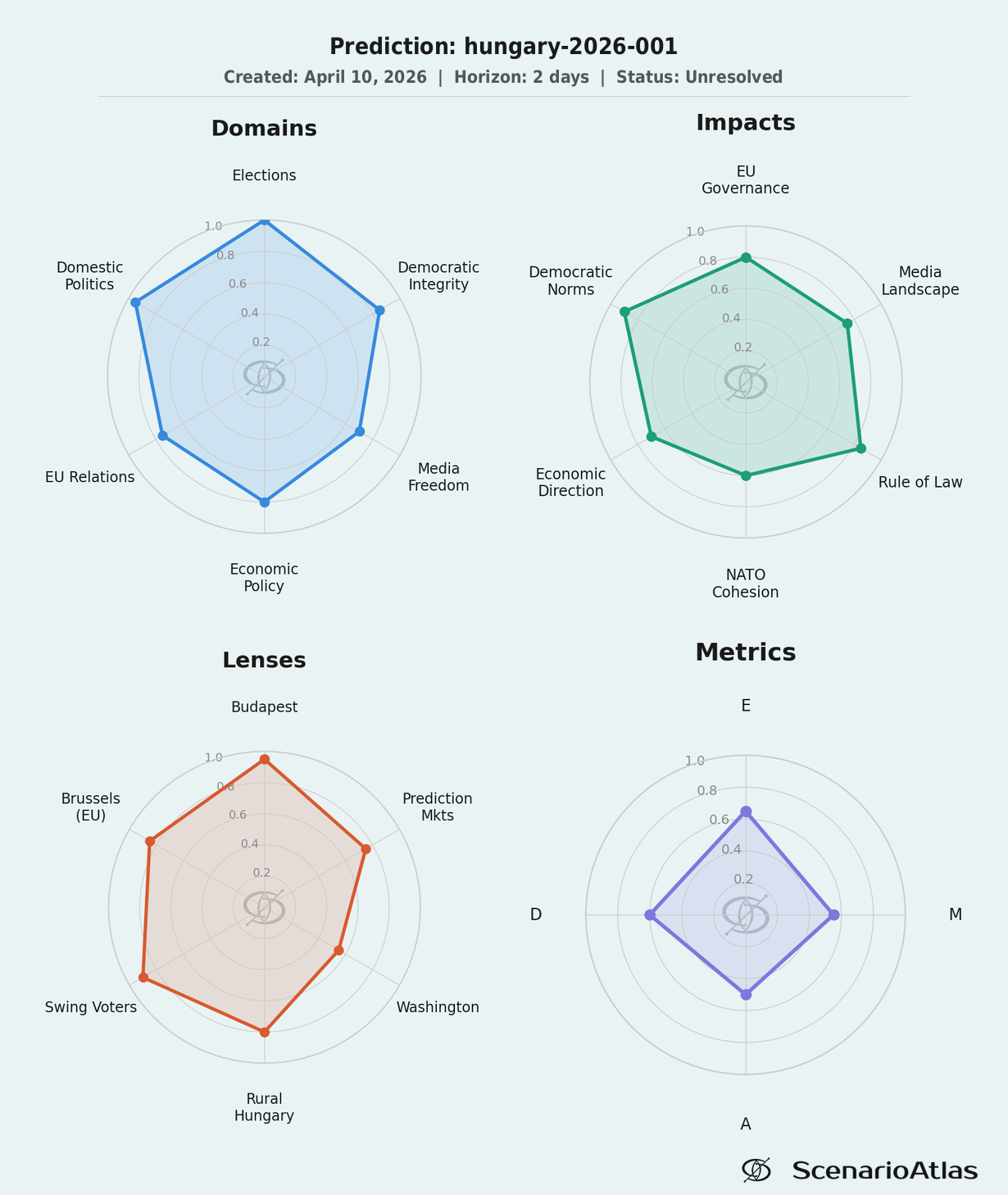
Overall Direction
Historical Base Rates
| Phenomenon | Rate | Source |
|---|---|---|
| 2022 Hungary polling error | Large | Opposition led in polls, Fidesz won decisively |
| Incumbent advantage (hybrid regimes) | 70% | V-Dem electoral autocracy dataset (n=15) |
| Unified vs fragmented opposition success | 55% | Post-Soviet electoral patterns (n=8) |
| High turnout benefits opposition | 60% | Hungary 1990–2022 elections (n=12) |
Key insight: 2026 differs from 2022 in three ways: unified opposition (not 6-party coalition), no external shock (Ukraine war started days before 2022 vote), and economic rather than security focus. These differences suggest a smaller polling error — but structural advantages (gerrymandering, media control, patronage) persist.
Five Scenarios
1. TISZA Majority (100+ seats)
TISZA wins outright majority. High turnout >70%. Takes FPTP districts in swing regions.
Drivers: Unified opposition, economic discontent, Magyar's swing voter appeal, youth mobilization.
Blockers: Gerrymandering (~10-15 seat bonus to largest party), rural Fidesz media dominance.
2. TISZA Narrow Win (85-99 seats)
TISZA wins plurality but needs coalition partners. Small parties may not clear threshold.
Risk: Coalition negotiations could fail. Structural correction for gerrymandering and rural advantage.
3. Fidesz Retains Power (85+ seats)
2022 pattern repeats. Machine politics delivers rural turnout. Patronage network holds.
Drivers: Historical pattern, rural patronage, media dominance, gerrymandering.
Blockers: Worse economy, no war shock, Magyar more effective than 2022 opposition.
4. Hung Parliament
Neither bloc reaches 100. Mi Hazánk or other small parties become kingmakers.
Blocker: Hungarian system tends to produce majorities due to FPTP component.
5. Fidesz Landslide (110+ seats)
Full 2022 repeat. TISZA collapses, massive polling error. Requires October surprise damaging Magyar + complete polling failure. No structural reason for 2022-level error with unified opposition.
Wild Cards
| Trigger | % | Effect | Watch For |
|---|---|---|---|
| EU funds released pre-election | 10% | Fidesz +3-5pp ("I delivered") | EC announcements, Orbán-Brussels meetings |
| Magyar scandal | 8% | TISZA -10pp → Fidesz wins | Coordinated Fidesz media attack, leaked documents |
| Economic shock (forint crash) | 7% | Anti-incumbent → TISZA +3pp | HUF/EUR rate, MNB emergency measures |
| Ukraine escalation (border) | 6% | Rally-around-flag → Fidesz +5pp | NATO alerts, Hungarian military activity |
| Orbán health crisis | 5% | Fidesz fragmentation | Cabinet reshuffles, reduced appearances |
Election Day Indicators
Resolution Tracking
| Prediction | Deadline | Our Call | Outcome | Correct? |
|---|---|---|---|---|
| TISZA wins (majority or plurality) | Apr 12 | 62% likely | TBD | TBD |
| Fidesz retains power | Apr 12 | 30% likely | TBD | TBD |
| TISZA wins outright majority (100+) | Apr 12 | 32% likely | TBD | TBD |
| Turnout exceeds 70% | Apr 12 | 55% likely | TBD | TBD |
Verdict
TISZA is favored but Fidesz is not beaten.
The structural differences from 2022 are real: unified opposition, no war shock, economic discontent. Prediction markets reflect this. But Fidesz has won every election since 2010, controls the media landscape in rural Hungary, benefits from gerrymandering, and has a patronage network that mobilizes voters who don't show up in polls.
The 28% Fidesz probability is not a formality — it reflects a genuine structural path to victory. Anyone who confidently predicts TISZA hasn't studied 2022 closely enough. Anyone who assumes Fidesz will repeat 2022 hasn't accounted for how much the context changed.
Confidence: 55%. Democratic election with observable data (prediction markets, base rates). Key uncertainty: whether 2022's polling error was structural (Fidesz machine) or contextual (war shock + fragmented opposition).
Framework: D/E/M/A. Published April 10, 2026. All predictions scored on resolution.
References
Frequently Asked Questions
Who will win the Hungary 2026 election?
TISZA (Peter Magyar) is favored at 62% combined win probability. Fidesz (Viktor Orban) retains a viable path at 28%. Unlike 2022, the opposition is unified under a single party.
When is the Hungary 2026 parliamentary election?
The Hungary 2026 parliamentary election takes place on April 12, 2026. Results are expected the same evening.
Can Fidesz win the 2026 Hungarian election?
Fidesz has a 28% probability of retaining power. Machine politics, gerrymandering, and rural media dominance give Orban structural advantages. However, 2026 differs from 2022 due to unified opposition and economic focus.
Every prediction scored. Every miss published.