

Iran-US Ceasefire: 52% Extension Probability
52% probability the ceasefire extends past April 23. Day 50 of the US-Israel war on Iran. Supreme Leader Ali Khamenei killed February 28. His son Mojtaba (42 days in office) faces maximum pressure: 85% of petrochemical exports destroyed, Strait of Hormuz closed. Trump's deal-making pattern and Iran's survival needs outweigh current rhetoric. Key risk: 35% probability strikes resume if talks collapse.
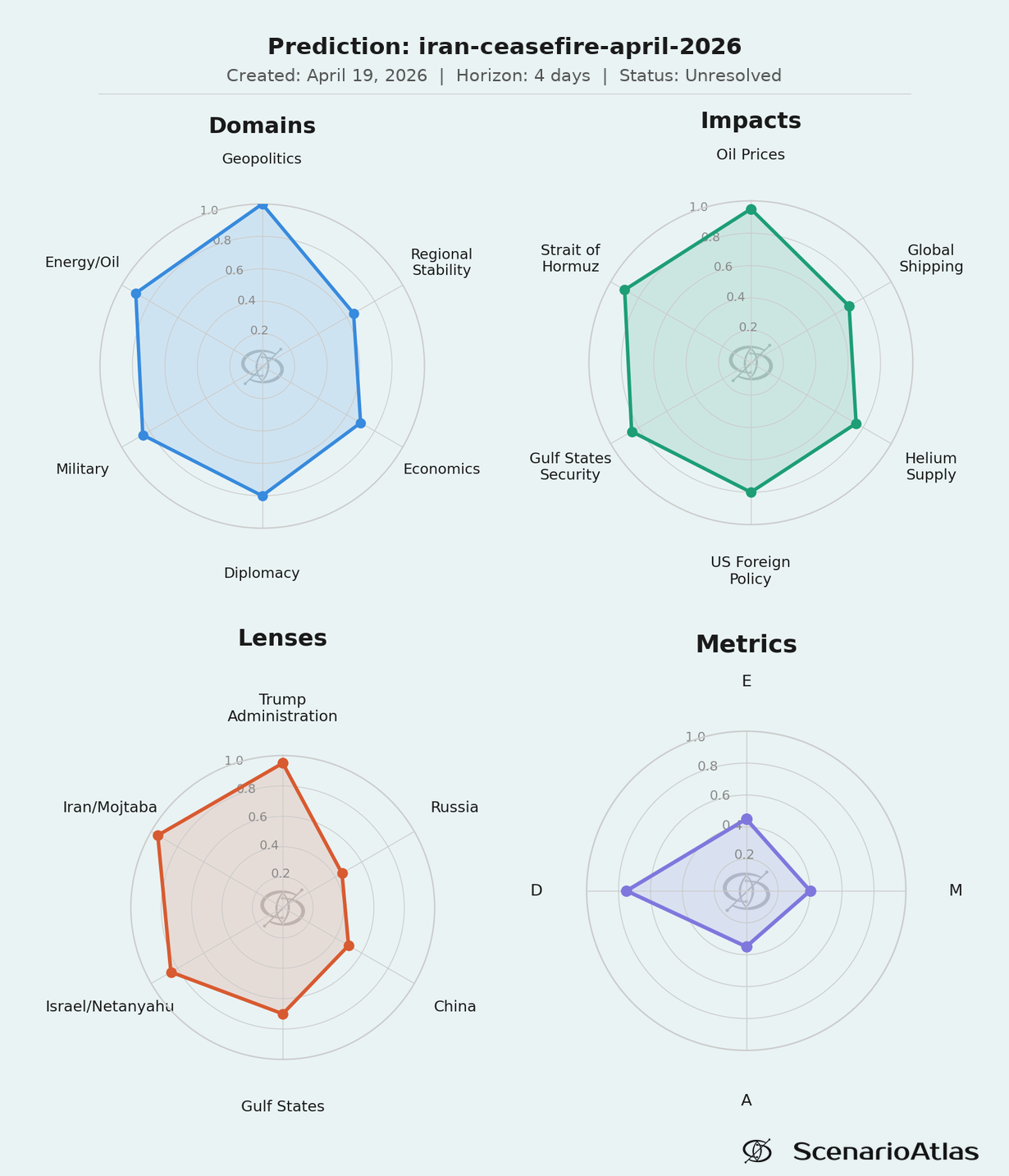
Probability Scores
Current Situation
| Metric | Value | Source |
|---|---|---|
| War day | 50 | Since Feb 28 |
| Ceasefire expires | April 23 (Wed) | USAToday |
| Supreme Leader | Mojtaba Khamenei | Since Mar 8 |
| Days in office | 42 | Calculated |
| Iran exports destroyed | 85% | ISW Apr 6 |
| Strait of Hormuz | CLOSED | Apr 18 |
| Oil (Brent) | $83-96 | Markets |
| Qatar LNG destroyed | 17% | CBS News |
| Trump statement | "Most points agreed" | Apr 18 |
| Iran attacks during ceasefire | UAE, Kuwait, Qatar, Bahrain | Al Jazeera |
Key Entities
USA (Trump Administration)
Core: Deal-maker identity, America First, No ground wars, Maximum pressure
Patterns: Brinkmanship → deal (NK, China), Tweet diplomacy, Unpredictability as strategy
Surface: Naval blockade continues, Claiming "most points agreed", Needs foreign policy win before midterms
Iran (Islamic Republic)
Core: Regime survival, Resistance identity, Nuclear threshold as deterrent
Patterns: Escalate → negotiate, Proxy networks, Strategic patience
Surface: 85% exports destroyed, New untested leader (42 days), Strait closed, Hardline rhetoric
Mojtaba Khamenei
Core: Regime continuity, Father's legacy
Patterns: Unknown — only 42 days in role
Surface: Untested under maximum pressure, Must prove strength, IRGC relationship unclear
Five Scenarios
1. Ceasefire Extended
Both sides exhausted. Trump wants deal win. Mojtaba needs time to consolidate. Back-channels active despite public rhetoric. Ceasefire extended 1-2 weeks.
Drivers: Mutual exhaustion, Trump deal-making pattern, Iran regime survival need, Back-channel signals.
Blockers: Mutual distrust, Strait still closed, Gulf attacks continue, Israel pressure.
2. Limited Strikes Resume
Ceasefire expires without extension. Trump follows through on threat. Targeted strikes on military infrastructure. Not full escalation.
Drivers: Trump credibility on threat, Iran hardliners win, Israel pushes for more.
Blockers: Escalation spiral risk, Oil price spike, International pressure.
3. Framework Deal
Surprise breakthrough. Basic terms announced: sanctions relief for nuclear limits. Details TBD.
Drivers: Desperation both sides, Economic pressure on Iran, Trump needs win.
Blockers: Too fast, Mojtaba can't appear weak, Israel resistance.
4. Major Escalation
Miscalculation or third-party incident triggers wider conflict. Direct US-Iran military engagement.
Drivers: Miscalculation, Iran attacks US ship, Israel strikes Tehran.
Blockers: Both want off-ramp, China/Russia pressure, Economic devastation.
5. Third-Party Incident
India, China, or neutral country ship attacked. New front opens. International coalition pressure.
Drivers: India ships already attacked, Neutral shipping at risk.
Blockers: International isolation for Iran, Not in Iran's interest.
D/E/M/A Uncertainty Decomposition
D (Data Quality: 0.75) — Good data from ISW, multiple news sources agree on facts. Gaps: back-channel status unknown, IRGC internal dynamics, real damage assessment.
E (Epistemic: 0.45) — Moderate reducible uncertainty. Mojtaba's decision-making is unknown (42 days in role). Iran's actual negotiating position unclear. Israel's next move uncertain.
M (Model: 0.40) — Moderate structural uncertainty. Iran historically follows "escalate → negotiate" pattern, but new leader may break pattern. Trump's deal-making is documented but unpredictable timing.
A (Aleatoric: 0.35) — Moderate irreducible randomness. Military operations have inherent uncertainty. Miscalculation risk. Black swan events (US ship attacked, Tehran strike) could reset all scenarios.
Black Swans
| Event | Probability | Impact |
|---|---|---|
| Iran attacks US Navy ship directly | 5% | Major escalation certain |
| China announces mediation/security guarantee | 8% | Deal +20pp |
| Mojtaba replaced / IRGC coup | 3% | All scenarios reset |
| Israel strikes Tehran (leadership target) | 6% | Major escalation, regional war |
| Oil hits $150 — global recession trigger | 10% | Massive pressure for deal |
Global Impacts
Oil
Current: $83-96 (volatile, depends on Strait status)
If ceasefire: Drop to $75-80
If strikes: Spike to $110-130
Helium Crisis
Status: CRISIS
Cause: Qatar = 1/3 global supply, 17% capacity destroyed
Recovery: 3-5 years
Affected: Semiconductors, Medical equipment, Scientific research
Shipping
Strait of Hormuz: CLOSED (April 18)
Affected: 20% of global oil transit
Neutral ships: India-flagged vessels attacked
What to Watch
Resolution Tracking
| Prediction | Deadline | Our Call | Outcome | Correct? |
|---|---|---|---|---|
| Ceasefire extended or deal announced | Apr 23 | 58% | TBD | TBD |
| Strikes resume | Apr 23 | 35% | TBD | TBD |
| Major escalation | Apr 23 | 7% | TBD | TBD |
Bottom Line
The ceasefire will most likely be extended, but it's close. Both sides are exhausted — Iran's economy is devastated (85% exports destroyed), Trump wants a foreign policy win. The dominant driver is Mojtaba Khamenei's position: untested leader, 42 days in role, must balance strength signaling with regime survival.
Key insight: Public rhetoric ≠ private negotiations. Iran attacking Gulf states during ceasefire while back-channels remain active is classic "escalate → negotiate" pattern. Watch for Pakistan/Qatar shuttle diplomacy as the signal of extension.
Resolution: April 23, 2026
We'll publish a retrotrack with full accuracy metrics when this prediction resolves. Follow us to get the update.
Track Our Accuracy
Our predictions are scored with Brier scores and published transparently.
Frequently Asked Questions
Will the Iran-US ceasefire be extended past April 23?
Our analysis assigns 52% probability to ceasefire extension. Both sides are exhausted — Iran lost 85% of exports, Trump wants a deal win. The 35% strikes probability captures the scenario where talks fail and Trump follows through on threats.
Who is Mojtaba Khamenei?
Mojtaba Khamenei became Supreme Leader of Iran on March 8, 2026, after his father Ali Khamenei was killed in a US-Israeli airstrike on February 28. He has been in office only 42 days and is untested under maximum pressure.
Why is the Strait of Hormuz closed?
Iran closed the Strait of Hormuz on April 18, 2026, after briefly opening it April 17. This blocks 20% of global oil transit. Iran also attacked India-flagged ships despite the ceasefire.
What is the global helium crisis?
Qatar supplies 1/3 of global helium. Iranian attacks destroyed 17% of Qatar's LNG capacity, causing a helium crisis affecting semiconductors, medical equipment, and scientific research. Recovery will take 3-5 years.
Every prediction scored. Every miss published.