

Trump Third Ultimatum: Four Scenarios for Hormuz by April 7
This is Trump's third 48-hour ultimatum to Iran. Base rate: he executes ~35% of military threats, and credibility decays ~30% with each repeated deadline. Our D/E/M/A framework assigns 40% to partial/limited strikes, 25% to full escalation, 25% to another deadline extension, and 10% to a diplomatic breakthrough. Hormuz has an 80% probability of remaining closed through April 10. Urea prices face a +15% central estimate (range: +5% to +30%). Confidence: 60%, L2 — first geopolitical prediction using D/E/M/A framework (Data Quality · Epistemic · Model · Aleatoric).
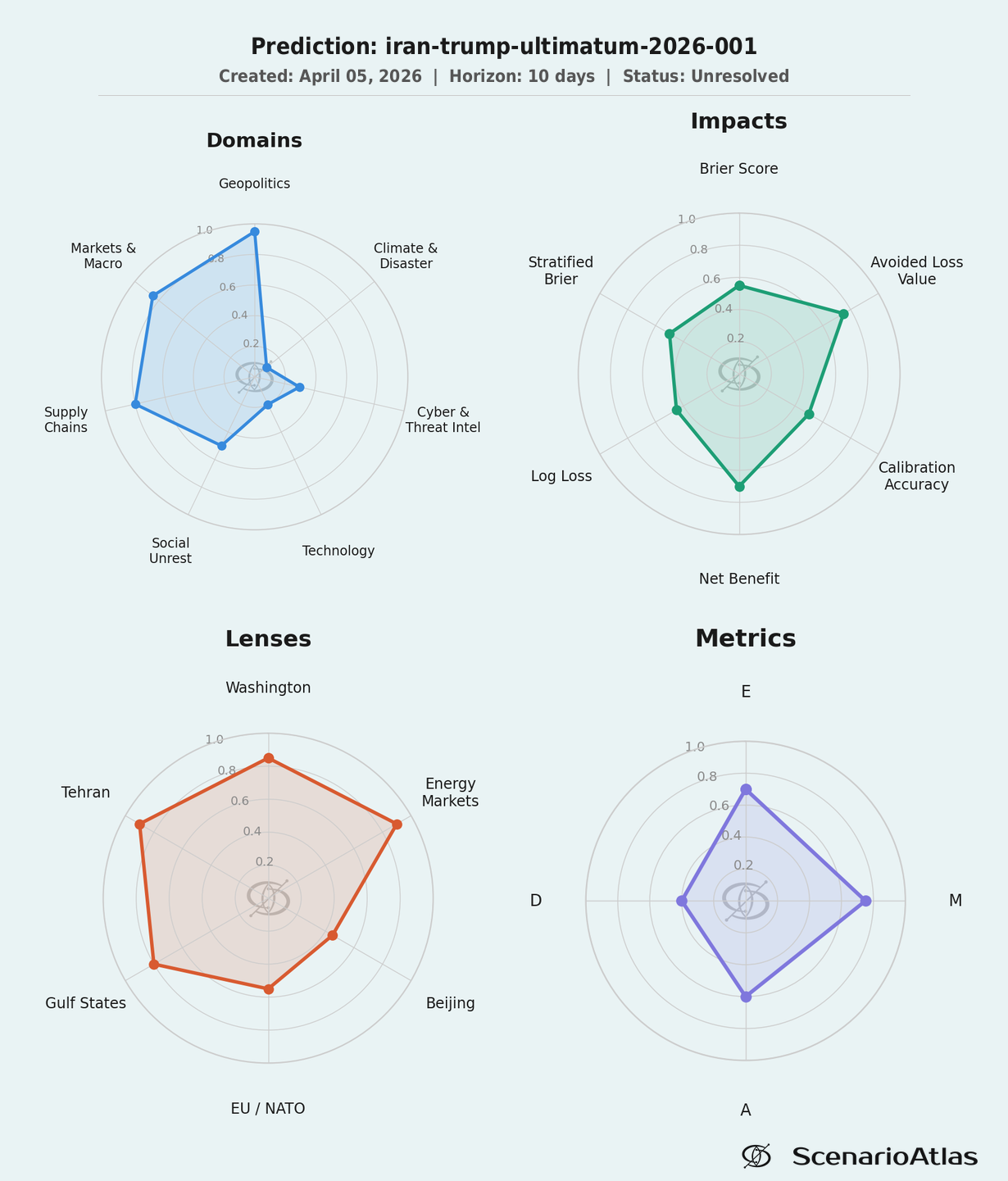
Probability Scores
Base Rates: Why the Third Ultimatum Matters
| Metric | Rate | Source |
|---|---|---|
| Trump promise fulfillment (1st term) | 42% | Emory Thesis |
| Trump promise fulfillment (2nd term) | ~20% | PolitiFact MAGA-Meter |
| Trump military threats executed | ~35% | Historical: NK "fire and fury" (no), Suleimani (yes), JCPOA exit (yes but not military) |
| Repeated ultimatum credibility decay | -30% each | Pattern analysis: 3rd deadline, each extension reduces probability |
The base-rate approach is critical here. Trump's overall promise fulfillment rate dropped from ~42% in his first term to ~20% in his second term (PolitiFact). For military threats specifically, the execution rate is approximately 35% — the "fire and fury" North Korea threat was not executed, the Suleimani strike was. But this is the third 48-hour ultimatum to Iran. Each repetition without action degrades the threat's credibility by roughly 30% (pattern analysis). The March 21 ultimatum was extended to March 26. The March 26 deadline was extended to April 6. Now April 6 looms.
That credibility decay creates a paradox: if Trump doesn't act this time, the threat instrument loses residual value entirely. That creates real pressure toward some form of action — but not necessarily the maximal version he describes. This is why our highest-probability scenario is "Measured Response" (40%), not "All Hell Rains Down" (25%).
Context
The war began February 28, 2026, when the U.S. and Israel launched surprise strikes on Iran. Thirty-six days later, the Strait of Hormuz remains effectively closed — a 94% traffic reduction since March 1 according to Lloyd's List Intelligence. Oil sits above $100/bbl. The F-15E Strike Eagle was shot down on April 3 — the first U.S. aircraft lost to enemy fire in over 20 years — and the weapons systems officer has only just been rescued from deep inside Iranian mountains after 36 hours behind enemy lines.
Iran has rejected the U.S. 15-point proposal as "unrealistic, illogical and excessive." Iran's central military command called Trump's latest threat "a helpless, nervous, unbalanced and stupid action." The indirect negotiations — led by VP Vance and Iran's parliamentary speaker Ghalibaf via Pakistan's Field Marshal Munir — have reportedly reached an impasse, with Pakistan concluding that the gaps are too wide.
The background conditions that make this assessment operationally relevant rather than theatrical: 365 U.S. service members injured, Hormuz blocking 20% of global oil transit, gas above $4/gallon in the U.S., and Trump's own April 1 national address where he promised to hit Iran "extremely hard" over the next two to three weeks.
Four Scenarios with Commodity Impact
■ All Hell Rains Down
Triggers: Major strikes on Iran power plants, bridges, energy infrastructure
Urea: +40–60%
Oil: +30–50%
Fertilizer stocks (NTR/CF/MOS): +15–30%
Hormuz: Remains closed or worsens
U.S. casualties: Significant increase
■ Measured Response
Triggers: Limited targets — radar, missile sites, military-only
Urea: +10–20%
Oil: +10–15%
Fertilizer stocks: +5–15%
Hormuz: Unchanged
U.S. casualties: Moderate
■ Another Extension
Triggers: New "request" from Iran, backchannel talks cited
Urea: -5% to +5%
Oil: -5% to +5%
Fertilizer stocks: -5% to +5%
Hormuz: Unchanged
U.S. casualties: Status quo
■ Diplomatic Deal
Triggers: Iran opens Hormuz, ceasefire agreement
Urea: -10–20%
Oil: -15–25%
Fertilizer stocks: -10–15%
Hormuz: Reopens
U.S. casualties: Stop
Commodity Deep Dive: Urea & Fertilizer
Iran exports 5–7 million tons of urea per year. The war and sanctions have already disrupted this supply. Our central estimate is a +15% price increase by April 15 (range: +5% to +30%, confidence: 55%). The wide range reflects compound uncertainty: gas prices feeding into ammonia production costs, the Hormuz chokepoint affecting all Gulf fertilizer exports, and the uncertainty premium that traders are already pricing in.
For fertilizer equities (Nutrien NTR, CF Industries CF, Mosaic MOS), we project +8% average performance by April 15 (range: -5% to +20%, confidence: 50%). The bull case is straightforward: supply disruption raises prices, benefiting producers. The bear case: energy cost pass-through, demand destruction at extreme price levels, and broader market risk-off sentiment. The wide range and low confidence reflect this genuine two-way risk.
D/E/M/A Uncertainty Decomposition
Our framework decomposes uncertainty into four channels — each mapped on the Metrics radar: D (Data Quality — how complete and reliable is the information?), E (Epistemic — reducible uncertainty that better analysis could narrow), M (Model limitations — structural gaps in our analytical framework), and A (Aleatoric — irreducible randomness and black swan events). For this prediction: Data is limited (D: 0.40) because backchannel negotiations are opaque. Epistemic uncertainty is high (E: 0.70) because better intelligence could significantly narrow the probability ranges. Model uncertainty is the highest (M: 0.75) because this is our first geopolitical prediction with no calibration history. Aleatoric risk is substantial (A: 0.60) — events like the F-15 shootdown or a sudden Iranian concession are inherently unpredictable.
Black Swans (A)
We do not see internal White House, Pentagon, or CENTCOM deliberations. We do not know the true state of backchannel negotiations — Pakistan says talks failed, Trump says they're going well, Iran denies talks exist. Public rhetoric may serve multiple audiences simultaneously: Iran, Gulf states, oil markets, domestic voters, Israel. The F-15 rescue complicates assessment: Trump may use the heroic rescue narrative as a springboard for either escalation or de-escalation.
Alternative Interpretations (ALT)
ALT-1: The threat is mainly designed to maximize pressure while preserving flexibility, not to commit Trump to a specific strike path. This is the "bargaining instrument" reading — the most common Trump pattern.
ALT-2: The rhetoric may be intended to create room for a symbolic Iranian concession that Trump can frame as victory without major escalation. Trump told Fox News on Sunday there was a "good chance" of a deal on Monday — potentially pre-staging this narrative.
ALT-3: The threat is aimed at third parties: Gulf states who should "come up and grab" the oil, European allies being pressured to join a maritime coalition, and oil markets where volatility serves U.S. domestic energy producers.
What to Watch
Invalidation Criteria
The assessment weakens if: (1) no meaningful military action occurs by April 7 and the deadline is extended yet again — this would further confirm the "crying wolf" pattern and shift weight from Measured Response to Another Extension; (2) Trump quickly accepts a symbolic gesture and reframes it as success; (3) Hormuz shows any reopening signals (ship AIS data, insurance downgrades). The assessment strengthens if: (1) the Monday press conference announces specific new targets; (2) CENTCOM issues new strike warnings; (3) Tuesday arrives and infrastructure attacks begin as threatened ("Power Plant Day").
Resolution Tracking
| Prediction | Deadline | Our Call | Outcome | Correct? |
|---|---|---|---|---|
| Ultimatum execution | Apr 7 | Partial escalation (40%) | TBD | TBD |
| Hormuz status | Apr 10 | Remains closed (80%) | TBD | TBD |
| Urea FOB ME price | Apr 15 | +15% (range +5–30%) | TBD | TBD |
| Fertilizer stocks | Apr 15 | +8% (range -5–20%) | TBD | TBD |
| Trump approval shift | Apr 15 | Decline (55%) | TBD | TBD |
| Overall trajectory | Apr 15 | Escalate (55%) | TBD | TBD |
Verdict
The most likely outcome is a measured escalation — targeted strikes on military infrastructure that demonstrate resolve without triggering the maximal civilian-infrastructure scenario.
The credibility paradox is the key dynamic: Trump's repeated-ultimatum pattern has degraded the threat's signaling value, creating pressure toward some action to restore credibility. But "some action" is not the same as "all hell." The 35% base rate for military threat execution, decayed by 30% per repeated deadline, suggests the full-escalation scenario is over-weighted in media coverage relative to its actual probability.
For commodity positions: urea and fertilizer equities have asymmetric upside under three of four scenarios. Only the Diplomatic Deal scenario (10%) produces downside. The risk/reward favors long exposure with tight stops, though confidence is genuinely low (50–55%) and ranges are wide.
Uncertainty type: MODEL. Framework: D/E/M/A framework (Data Quality · Epistemic · Model · Aleatoric). First geopolitical prediction using D/E/M/A — no track record to calibrate against. Base rates sourced from Emory Thesis, PolitiFact, FactCheck.org. Published April 5, 2026. All predictions will be scored with Brier scores by April 15.
Every prediction scored. Every miss published.