

North Korean Succession: Kim Ju-ae as Designated Heir
Kim Ju-ae (born c. 2013), daughter of Kim Jong Un, has been systematically elevated in DPRK state media since November 2022. We assess a 35% probability she eventually assumes supreme leadership — the highest single-scenario probability — but base rates for female child heirs in authoritarian regimes are historically unfavourable. Overall confidence is low (25%) due to compounding unknowns across every analytical dimension.
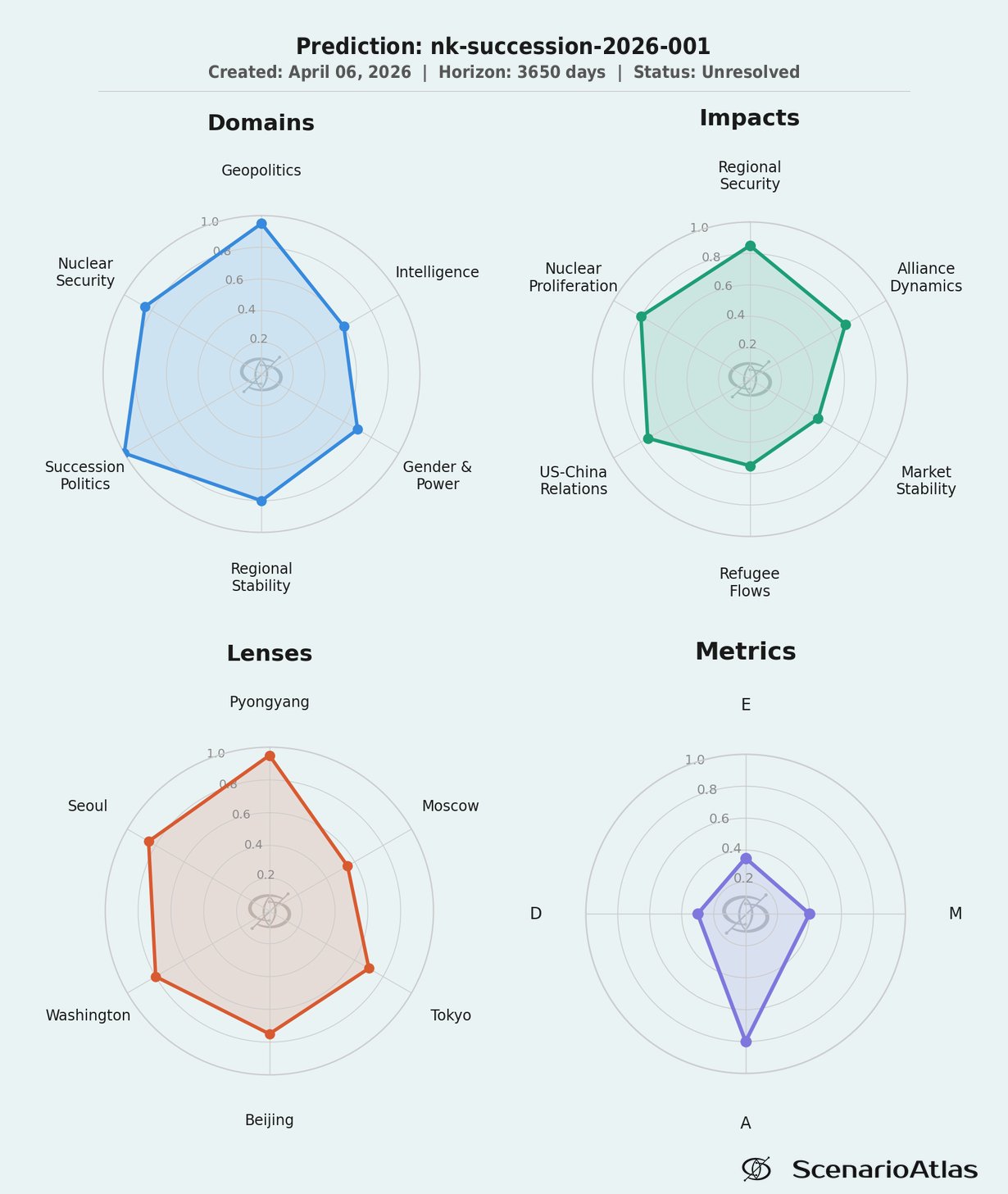
Probability Scores
Base Rates
Kim Ju-ae's candidacy sits at the intersection of several well-documented statistical patterns. The DPRK is 2-for-2 on hereditary succession — a perfect record — but global cross-national data tells a starkly different story.
| Factor | Rate | Source |
|---|---|---|
| Hereditary succession in personalist regimes | 47% | Brownlee, World Politics 59(4), 2007 doi:10.1353/wp.2008.0002 |
| Female leadership in authoritarian transitions | 3% | Geddes, Wright & Frantz, How Dictatorships Work, Cambridge UP, 2018 doi:10.1017/9781316336182 |
| Child heirs (<18) successfully assuming power | 12% | Kokkonen & Sundell, Journal of Politics 76(1), 2014 doi:10.1017/S0022381613001266 |
| Regency arrangements surviving to heir maturity | 29% | Svolik, The Politics of Authoritarian Rule, Cambridge UP, 2012 doi:10.1017/CBO9781139176040 |
| DPRK hereditary succession track record | 100% | Madden, 38 North, 2019 38north.org |
| Regime survival through leadership transition | 58% | Frantz & Kendall-Taylor, Journal of Peace Research 51(3), 2014 doi:10.1177/0022343313519808 |
The tension between the DPRK's perfect internal record and the unfavourable global averages — particularly the 3% rate for female authoritarian succession and 12% for child heirs — is the central analytical challenge. Both prior DPRK successions involved adult male heirs with at least two years of institutional positioning. Neither condition currently applies to Kim Ju-ae.
Scenarios
Kim Ju-ae Completes Succession
Kim Jong Un dies or becomes incapacitated. Kim Ju-ae — by then in her late teens or early twenties — assumes supreme leadership with a regency arrangement, most likely involving Kim Yo Jong and OGD leadership.
Drivers: Two prior hereditary successions, Paektu bloodline ideology, sustained public visibility exceeding early grooming phases of prior heirs, OGD institutional infrastructure.
Blockers: Unprecedented age (~13 in 2026), possible older male sibling, gender barriers in patriarchal political culture, Kim Jong Un could live decades more.
Analogue: Kim Jong Un (2009–2011), Duvalier succession in Haiti (1971).
Prolonged Status Quo
Kim Jong Un lives and rules for another 20–30+ years. Succession remains deliberately ambiguous. Kim Ju-ae's visibility may be propaganda tool rather than succession signal.
Drivers: Kim Jong Un is ~41–42, could live into 60s–70s. Authoritarian leaders resist committing to heirs.
Blockers: Health risk factors create actuarial risk. Sustained Ju-ae appearances exceed propaganda purposes.
Analogue: Kim Il Sung's long rule (1948–1994).
Kim Yo Jong Emerges
Kim Jong Un dies before Kim Ju-ae is positioned. Kim Yo Jong assumes de facto or de jure control as regent or leader in her own right, leveraging existing institutional power.
Drivers: Already holds significant OGD power, direct Paektu bloodline, demonstrated propaganda competence.
Blockers: No precedent for female supreme leader in DPRK, no military rank, senior military resistance.
Male Heir Supersedes
Reports suggest Kim Jong Un has an older son (born c. 2010). This son could be repositioned as preferred heir, especially if military elites resist a female successor.
Drivers: Patriarchal norms favour male primogeniture, firstborn carries Confucian legitimacy weight.
Blockers: Older son never publicly presented, reversing Ju-ae's elevation is politically costly.
Elite Coup or Regime Fragmentation
Kim Jong Un's death triggers a power struggle. No Kim family member consolidates power. The DPRK fragments or undergoes military reorganisation. This is the highest-impact, lowest-probability scenario — and the one with the most severe global consequences including nuclear security risks, refugee flows, and a potential US–China crisis management test.
Analogues: Post-Gaddafi Libya, post-Tito Yugoslavia.
D/E/M/A Uncertainty Decomposition
D (Data Quality: 0.30) — Extremely poor. North Korea is the world's most opaque state. Basic facts about Kim Jong Un's family — number of children, genders, ages — remain unconfirmed. South Korean NIS assessments are the primary data source, themselves rated at moderate confidence. The 2-case DPRK historical base is too small for reliable extrapolation.
E (Epistemic: 0.35) — Low. Better analysis could narrow ranges marginally. Academic literature on hereditary succession provides useful cross-national base rates (Brownlee 2007, Geddes et al. 2018), but the DPRK's unique characteristics — Juche ideology, Paektu bloodline mythology, totalitarian information control — limit transferability. The gap between DPRK-specific precedent (100%) and global base rates (47%) is itself an epistemic challenge.
M (Model: 0.40) — Moderate structural gaps. The D/E/M/A framework assumes scenarios are mutually exclusive, but in practice multiple scenarios could overlap (e.g., Kim Yo Jong as regent leading to Kim Ju-ae's eventual succession). The 10-year horizon compounds model uncertainty — structural changes in North Korean elite politics could invalidate current assumptions.
A (Aleatoric: 0.80) — Very high irreducible randomness. Kim Jong Un's health, the timing of any succession event, elite loyalty calculations at the moment of crisis, and Chinese intervention decisions are fundamentally unpredictable. This is the dominant uncertainty channel.
Black Swans (A)
Several low-probability, high-impact events could invalidate the entire scenario framework:
Alternative Interpretations (ALT)
ALT-1: Kim Ju-ae as political shield, not heir
Kim Ju-ae's visibility may serve to protect a hidden male heir from foreign intelligence targeting. By presenting a daughter publicly, Kim Jong Un shields his actual designated successor from the scrutiny and potential targeting that accompanied Kim Jong Un's own grooming period. If true, Ju-ae's probability drops to near zero and the male heir scenario rises correspondingly.
ALT-2: Dual-track succession
Kim Jong Un may be deliberately maintaining ambiguity — grooming both Kim Ju-ae and an unseen male heir — to retain maximum flexibility and prevent premature factional alignment. This is consistent with how Kim Il Sung managed succession dynamics before ultimately settling on Kim Jong Il relatively late.
ALT-3: Kim Yo Jong as the actual plan
Kim Ju-ae's elevation may serve to normalise a female authority figure within DPRK political culture, making Kim Yo Jong's eventual assumption of power more palatable to military elites. Ju-ae as precedent-setter rather than successor.
What to Watch
Invalidation Criteria
This analysis would require significant revision if any of the following occur: Kim Ju-ae disappears from public events for 6+ months without explanation; a male Kim child is publicly introduced with institutional positioning; Kim Jong Un publicly designates an alternative successor; or a confirmed health crisis forces immediate succession planning.
Resolution Tracking
| Prediction | Deadline | Our Call | Outcome | Correct? |
|---|---|---|---|---|
| Kim Ju-ae receives formal party/military title by 2030 | 2030-12-31 | 55% likely | TBD | TBD |
| Kim Ju-ae is publicly identified as successor within 10 years | 2036-04-06 | 45% likely | TBD | TBD |
| Male heir publicly presented by 2032 | 2032-12-31 | 20% likely | TBD | TBD |
| Kim dynasty retains power through next succession | Succession event + 1 year | 75% likely | TBD | TBD |
Verdict
Kim Ju-ae is the most likely single successor — but "most likely" is only 35%.
The DPRK's perfect 2-for-2 hereditary succession record creates a strong prior, but Kim Ju-ae faces unprecedented challenges that no prior Kim heir confronted: extreme youth, female gender in a patriarchal system, and a possible male sibling rival. Global base rates for these specific conditions are historically unfavourable (3% female succession, 12% child heirs, 29% regency survival). The most honest assessment is that grooming is happening — we can observe it — but the outcome remains deeply uncertain. A 25% status quo scenario (Kim Jong Un rules for decades more) is the most important reminder that the succession question may not arise for a very long time.
Uncertainty type: Compounded low-knowability. Framework: D/E/M/A (Data Quality · Epistemic · Model · Aleatoric). Published 6 April 2026. All predictions will be scored with Brier scores on resolution dates.
References
Frequently Asked Questions
Who will succeed Kim Jong-un in North Korea?
Kim Ju-ae is assessed at 35% probability as designated heir — the highest single scenario. Base rates show only 3% historical success for female autocratic succession and 12% for child heirs.
Is Kim Ju-ae the next leader of North Korea?
Our analysis assigns 35% probability to Kim Ju-ae succeeding. Alternative scenarios include prolonged status quo (25%), military regency (20%), Kim Jong-un relative (15%), and regime crisis (5%).
Every prediction scored. Every miss published.