

Semiconductor Supply Chain: Helium Crisis Impact on AI Chips, Memory, Storage
Qatar's Ras Laffan (30% of global helium) has been offline since March 2026 following Iranian strikes. DRAM already +95% QoQ in Q1 — a record. Q2 forecast: DRAM +60%, NAND +75%. Samsung and SK hynix signed emergency long-term agreements. The US-Iran conditional ceasefire (April 8) provides temporary relief but the structural shortage persists — capacity expansion not until Q4 2027. AI demand was already squeezing memory supply. The helium crisis compounds it.
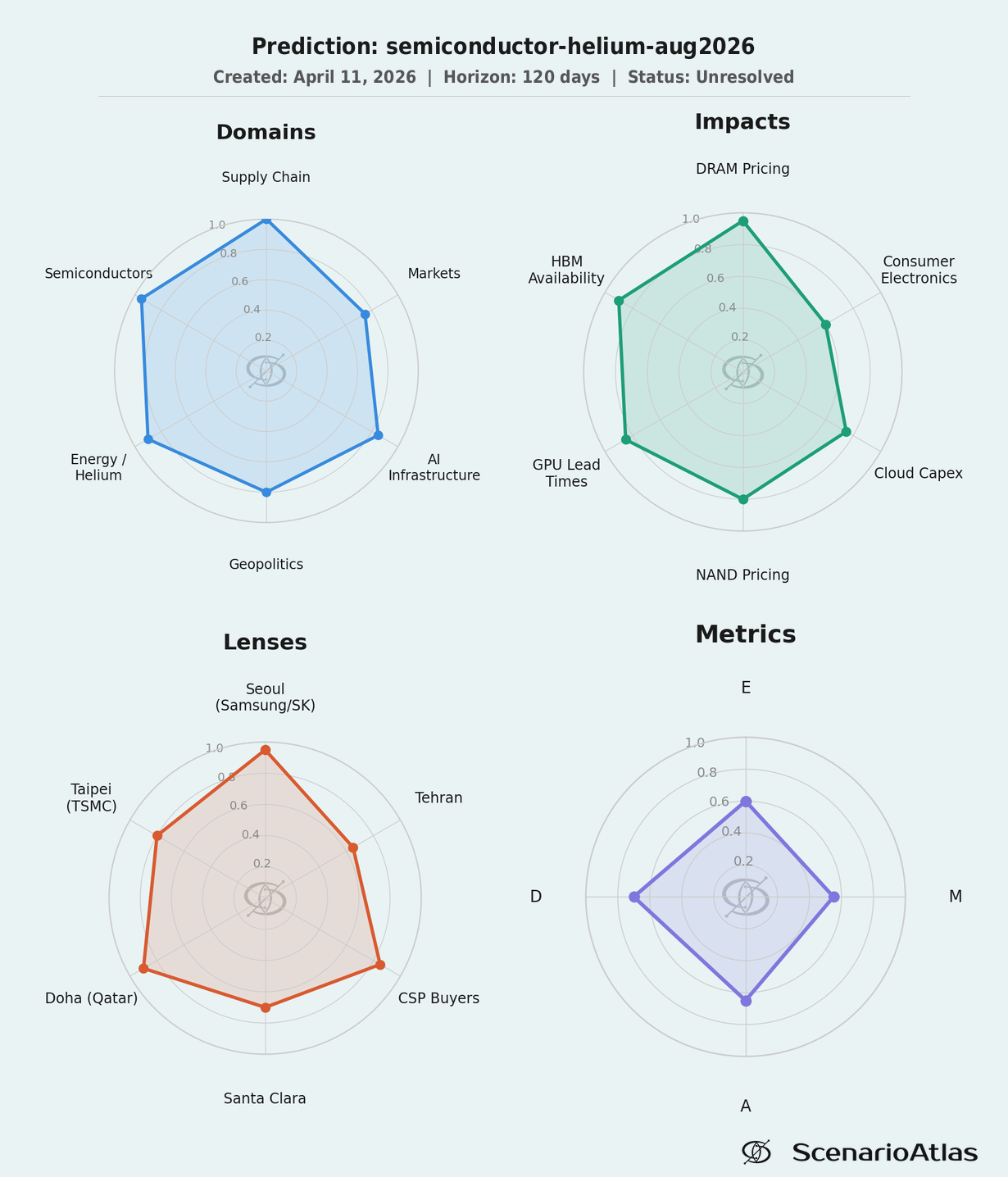
Probability Scores
Historical Base Rates
| Event | Outcome | Relevance |
|---|---|---|
| COVID Chip Shortage 2020-2022 | 18+ month disruption, prices 2-3x, structural changes | 80% |
| Japan Earthquake 2011 | DRAM +20% in 3 months, then normalized | 70% |
| Helium Shortage 2012-2013 | Prices +30-40%, MRI delays, limited semiconductor impact | 60% |
Analogous cases: China rare earth export restrictions (2010) saw 10x price spike then collapse as alternatives emerged — lesson: short-term spike, long-term substitution. Neon gas from Ukraine (2022) spiked but fabs had inventory and impact was limited — lesson: inventory buffers matter.
Base rate implication: Supply shocks typically cause 3-6 month disruption with 20-40% price impact. Helium has no substitute for semiconductor fab cooling — this could be worse than historical analogues.
Current Situation
| Metric | Value |
|---|---|
| Ras Laffan Status | Offline since Mar 2, 2026 |
| Global Helium Removed | 27-30% |
| Helium Spot Price | +40-100% from pre-war |
| DRAM Q1 2026 | +90-95% QoQ (record) |
| DRAM Q2 Forecast | +58-63% QoQ |
| NAND Q2 Forecast | +70-75% QoQ |
| DDR4 Spot (Apr 8) | $33.56/chip (1Gx8 3200MT/s) |
| HBM3E 2026 | +20% YoY (locked contracts) |
| US-Iran Ceasefire | 2-week conditional (Apr 8) |
| Data Quality (D) | 0.75 — Good price data, weak on actual inventory levels |
Four Scenarios
1. Managed Shortage
Ceasefire holds intermittently. US helium exports ramp. Samsung/SK hynix LTAs provide 3-6 month buffer. Fab recycling improves 10-15%. Prices continue rising at forecast rate, not accelerating.
Conditional: If ceasefire holds → 55%. If US reserve release → 60%.
Impact: DRAM +20-35%, NAND +30-45%, GPU lead time 3-4 months.
2. Helium Crunch
Ceasefire collapses or Qatar repair delayed beyond expectations. SK hynix or Samsung announces production guidance cut citing helium. Yields degrade, defect rates rise.
Conditional: If ceasefire fails → 55%. If second strike → 75%. If ceasefire holds → 20%.
Impact: DRAM +40-60%, NAND +50-70%, HBM severe constraints, GPU lead time 6+ months.
Trigger: Any production cut announcement = scenario confirmed.
3. Demand Destruction
Cloud capex cuts announced. AI winter signals emerge. Enterprise pulls back. Memory inventory builds. Price pressure eases despite supply constraints.
Conditional: If major CSP cuts → 40%. If recession confirmed → 35%.
Impact: DRAM -5% to +10%, GPU availability improves, lead times normalize to 4-6 weeks.
4. Iran Resolution
Comprehensive US-Iran deal. Hormuz fully reopens. Qatar repair accelerated with international support. Helium normalizes faster than expected.
Conditional: If Trump deal → 30%. If ceasefire extends 30d → 20%.
Impact: DRAM -10% to +5% (relief rally), lead times stabilize at 6-8 weeks.
D/E/M/A Uncertainty Decomposition
D (Data Quality: 0.75): Good coverage of price data and corporate statements from TrendForce, DRAMeXchange, and financial news. Weak on actual fab helium inventory levels — companies claim months of supply but verification is impossible. Qatar repair timeline estimates vary widely between sources.
E (Epistemic: 0.60): Historical base rates (COVID shortage, Japan 2011, Helium 2012) provide useful anchors but differ from current situation in key ways. Analogous case analysis (rare earths, neon gas) helps bound expectations but helium's non-substitutability makes extrapolation uncertain.
M (Model: 0.55): Conditional probability structure captures key branching points (ceasefire durability, reserve release, CSP demand). Model gap: interaction between geopolitical and demand-side variables not fully captured.
A (Aleatoric: 0.65): High irreducible uncertainty. Second Iranian strike (15%), CSP capex cut (12%), and China helium breakthrough (5%) are named black swans with detection signals but fundamentally unpredictable timing.
Black Swans (A)
| Trigger | % | Impact | Detection Signals |
|---|---|---|---|
| Second Iranian strike on Qatar | 15% | Catastrophic — DRAM +100% | IRGC threat escalation, US carrier movements, Qatar evacuation orders |
| Major CSP capex cut (Google/MS/Amazon) | 12% | High — prices stabilize | Pre-earnings whispers, hiring freezes, AI project cancellations |
| China domestic helium breakthrough | 5% | Medium — long-term relief | CCTV announcements, patent filings |
Cascade Triggers
| Trigger | % | Cascade |
|---|---|---|
| Second Iranian strike on Qatar | 15-20% | Additional 20% helium offline → immediate production cuts → DRAM +100% |
| Major CSP capex cut | 10-15% | Server DRAM demand drops → inventory builds → prices stabilize or fall |
| Trump-Iran comprehensive deal | 8-12% | Hormuz opens → Qatar resumes → relief rally → normalize Q4 |
Verification Metrics (Aug 15, 2026)
| Metric | Baseline | Helium Crunch | Managed | Demand Dest. |
|---|---|---|---|---|
| DDR4 Spot | $33.56 | >$50 | $40-50 | <$37 |
| Q3 DRAM Forecast | TBD (June) | >+40% QoQ | +20-40% | <+15% |
| Production Cut | None | Announced | None | None |
What to Watch
Key Uncertainties
Resolution Tracking
| Prediction | Deadline | Our Call | Outcome | Correct? |
|---|---|---|---|---|
| DDR4 spot above $40 by Aug 15 | Aug 15 | 60% likely | TBD | TBD |
| SK hynix or Samsung announces helium-related production cut | Aug 15 | 35% likely | TBD | TBD |
| H100/H200 GPU lead time exceeds 4 months | Aug 15 | 45% likely | TBD | TBD |
| Ras Laffan still offline | Aug 15 | 80% likely | TBD | TBD |
| US-Iran ceasefire collapsed before Aug 15 | Aug 15 | 55% likely | TBD | TBD |
Verdict
Two compounding shortages: AI-driven demand + helium supply shock. Most likely outcome is painful but manageable.
The Managed Shortage (40%) scenario assumes LTAs hold, US helium ramps, and the ceasefire doesn't fully collapse. But the Helium Crunch (35%) is a close second — any production cut announcement from Samsung or SK hynix shifts the probability immediately. The verification metrics are concrete: DDR4 spot above $50 = crunch confirmed, below $37 = demand destruction.
Historical base rates anchor expectations: COVID chip shortage (80% relevant) suggests 18+ months of disruption when demand and supply compound. But neon gas from Ukraine shows fabs can buffer through strategic inventory. The critical difference: helium has no substitute for semiconductor fab cooling.
The structural problem persists regardless of Iran: Ras Laffan repair takes years, Amur GPP is underperforming, and capacity expansion won't arrive until Q4 2027 at the earliest.
Confidence: 50%. Good price data (D: 0.75) but high aleatoric uncertainty (A: 0.65). Ceasefire durability is the swing variable. Model captures key branching points but interaction between geopolitical and demand variables adds structural uncertainty (M: 0.55).
Framework: D/E/M/A. Published 11 April 2026, updated 12 April. All predictions scored on resolution.
References
Frequently Asked Questions
How does the helium shortage affect semiconductor production?
Helium is critical for semiconductor manufacturing cooling and testing. Qatar going offline disrupted 30% of global supply. DRAM prices spiked 95% QoQ. Managed Shortage scenario at 40%, Helium Crunch at 35%.
Will memory chip prices increase in 2026?
DDR4 reached $33.56 per unit. Our analysis projects 40% probability of managed shortage with gradual price normalization, and 35% probability of sustained helium crunch with further price increases through August 2026.
Every prediction scored. Every miss published.