

Ukraine Ceasefire Architecture: Why Current Proposals Will Fail
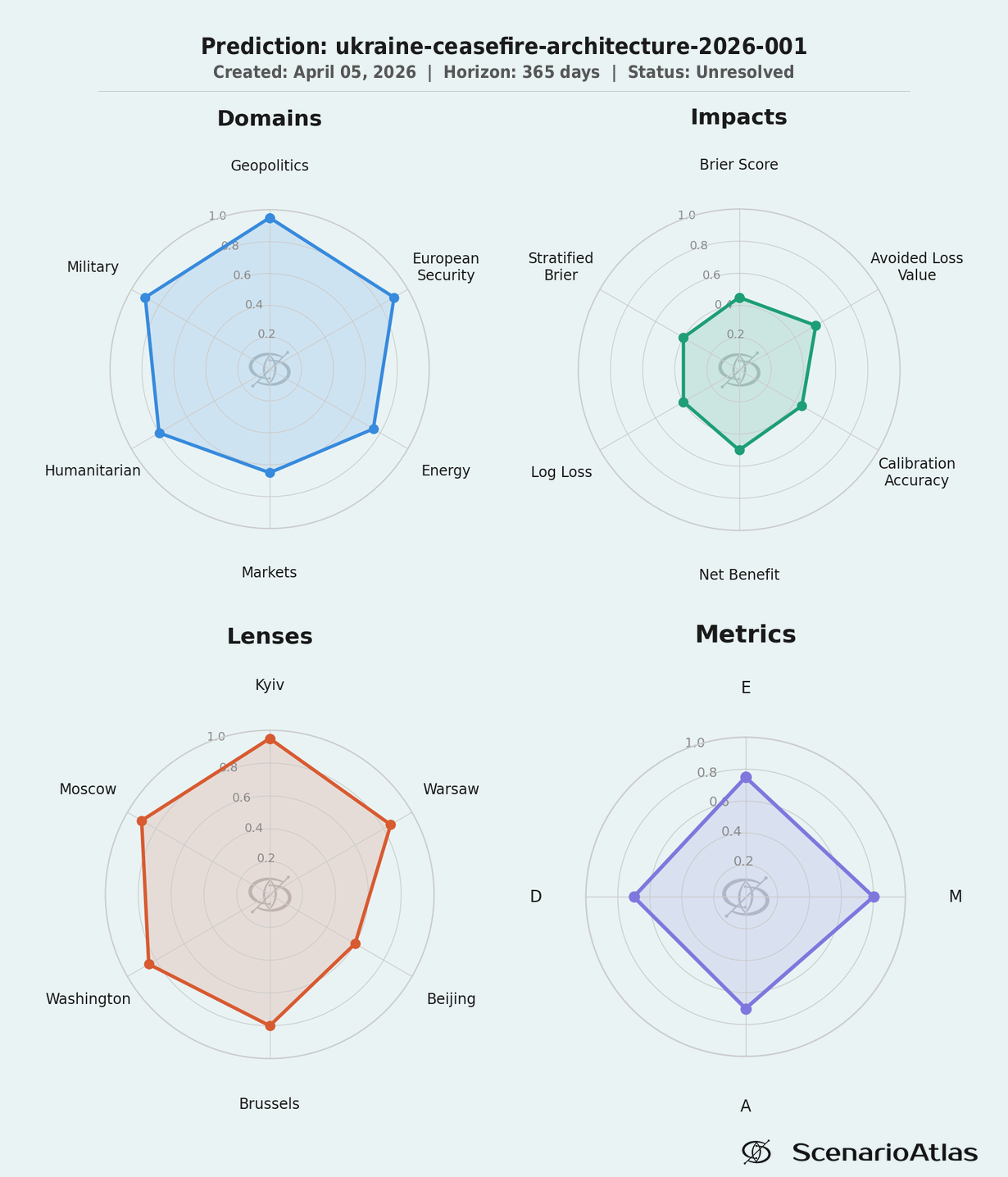
Russia occupies ~20% of Ukrainian territory. Zelensky's Easter ceasefire proposal was rejected - Russia launched 286 drones overnight. The US-backed Geneva proposal leaves key elements undefined. Security guarantees for Ukraine remain the central unresolved problem. Base rate: Minsk 1 collapsed within weeks, Minsk 2 was never implemented. Any ceasefire collapse leaves Ukraine militarily weaker. Our D/E/M/A framework assigns 40% to a fragile armistice (6-12 months), 30% to frozen conflict, 15% to comprehensive deal, 15% to temporary truce. Confidence: 55%, L3.
Probability Scores
The Central Problem: Security Guarantees
Every analyst discussing Ukraine ceasefire scenarios acknowledges the same core issue: without enforceable security guarantees, any ceasefire is a pause before the next war. Ukraine gave up its nuclear weapons in 1994 in exchange for security assurances from Russia, the US, and UK (Budapest Memorandum). Those assurances proved worthless in 2014 and 2022.
The current US-backed proposals discussed in Geneva leave this question undefined. The US has offered some form of security guarantee, but its National Security Strategy rhetoric toward Europe has undermined confidence that these guarantees would be honored. Ukraine is being asked to evacuate territory that comprises its defensive belt - withdrawal would require moving onto unprepared and indefensible terrain.
Base Rates: Ceasefire Durability
| Precedent | Duration | Enforcement | Outcome |
|---|---|---|---|
| Minsk I (Sept 2014) | Weeks | None | Collapsed immediately |
| Minsk II (Feb 2015) | Never implemented | Weak (OSCE monitors) | 7 years of violations |
| Korean Armistice (1953) | 70+ years | Strong (US presence) | No peace treaty, but stable |
| Cyprus (1974) | 50+ years | Strong (UN/NATO) | Frozen, but stable |
| Nagorno-Karabakh (1994) | 26 years | Weak | War resumed 2020 |
The pattern is clear: ceasefires with strong enforcement mechanisms (Korean, Cyprus) can last decades. Ceasefires without enforcement (Minsk, Nagorno-Karabakh) collapse when one party decides to resume. The current proposals for Ukraine fall into the second category - they emphasize process and dialogue without defining enforcement.
Four Scenarios with Durability Estimates
■ Fragile Armistice
Weaknesses: No security guarantees, undefined key elements, defensive belt evacuation
Timeline: Signed within 3 months
Durability: 6-12 months
Failure mode: Russia resumes when ready
■ Frozen Conflict
Weaknesses: No formal agreement, both sides exhausted, status quo accepted
Timeline: Onset within 1-3 months
Durability: Indefinite (Korea/Cyprus model)
Failure mode: Resumption when conditions change
■ Comprehensive Deal
Weaknesses: Requires massive international effort, Russian reluctance
Timeline: 6-12 months for framework
Durability: 2-5 years with monitoring
Failure mode: Compliance erosion over time
■ Temporary Truce
Weaknesses: Tactical only, no strategic resolution, Minsk precedent
Timeline: 1-2 months
Durability: <6 months
Failure mode: Collapses rapidly like Minsk I
The Abu Dhabi Problem
Analysis of the Abu Dhabi negotiations reveals a fundamental asymmetry. At the tactical level, Russia demonstrates engagement sufficient to satisfy Trump administration requirements while positioning itself favorably in international media. At the strategic level - where substantive resolution would require real compromise - Moscow exhibits zero flexibility.
The negotiations appear productive on procedural matters while remaining comprehensively deadlocked on existential questions: territorial sovereignty, security guarantees, NATO membership, and reparations. Russia has transformed negotiations into a cognitive warfare instrument rather than a peace process.
Why Ukraine Cannot Accept Current Terms
The US proposal requires Ukraine to evacuate the remainder of Donbas - territory that comprises its defensive belt. Withdrawal would require Ukrainian forces to move onto unprepared and indefensible terrain. The result: any collapse of a ceasefire during implementation would leave Ukraine in a much-weakened military position.
Zelensky faces domestic political constraints. Public opinion, parliamentary politics, and the memory of Budapest limit his ability to sign away territory - especially without enforceable guarantees that differ materially from 1994. The international community's credibility for future deterrence is also affected by how this conflict ends.
D/E/M/A Uncertainty Decomposition
D (Data Quality: 0.70) - Backchannel negotiations are opaque. Public statements serve multiple audiences (domestic, international, adversarial). Actual positions may differ significantly from stated positions.
E (Epistemic: 0.75) - Better intelligence on Russian decision-making, Trump administration priorities, and European coordination would narrow uncertainty. Key question: what security guarantee would Ukraine accept AND Russia tolerate?
M (Model: 0.80) - High model uncertainty. The Minsk precedent suggests failure, but current conditions differ (more military exhaustion, different US posture, European rearmament). Korean model may be more relevant than Minsk.
A (Aleatoric: 0.70) - Irreducible randomness includes: leadership changes (Putin health, US elections), military surprises, economic shocks affecting either side's capacity to continue.
What to Watch
Resolution Tracking
| Prediction | Deadline | Our Call | Outcome | Correct? |
|---|---|---|---|---|
| Ceasefire signed | Q3 2026 | 50% some form of agreement | TBD | TBD |
| Ceasefire durability | Q2 2027 | 60% collapses or frozen <12mo | TBD | TBD |
| Comprehensive peace | 2027 | 15% probability | TBD | TBD |
| Ukraine in NATO | 2030 | <10% during any ceasefire | TBD | TBD |
Bottom Line
Current ceasefire proposals repeat the structural errors of Minsk: they prioritize process over enforcement, leave security guarantees undefined, and require Ukraine to accept territorial vulnerability. Base rates from comparable conflicts suggest 70% probability of collapse within 2 years absent strong enforcement mechanisms. The most likely path is either a fragile armistice that collapses (40%) or a frozen conflict that persists indefinitely without resolution (30%). A comprehensive peace deal (15%) requires political will that is currently absent in Moscow, and possibly in Washington. The key variable is whether European security architecture can evolve to provide credible guarantees independent of US commitment - that would change the scenario probabilities significantly.
Every prediction scored. Every miss published.